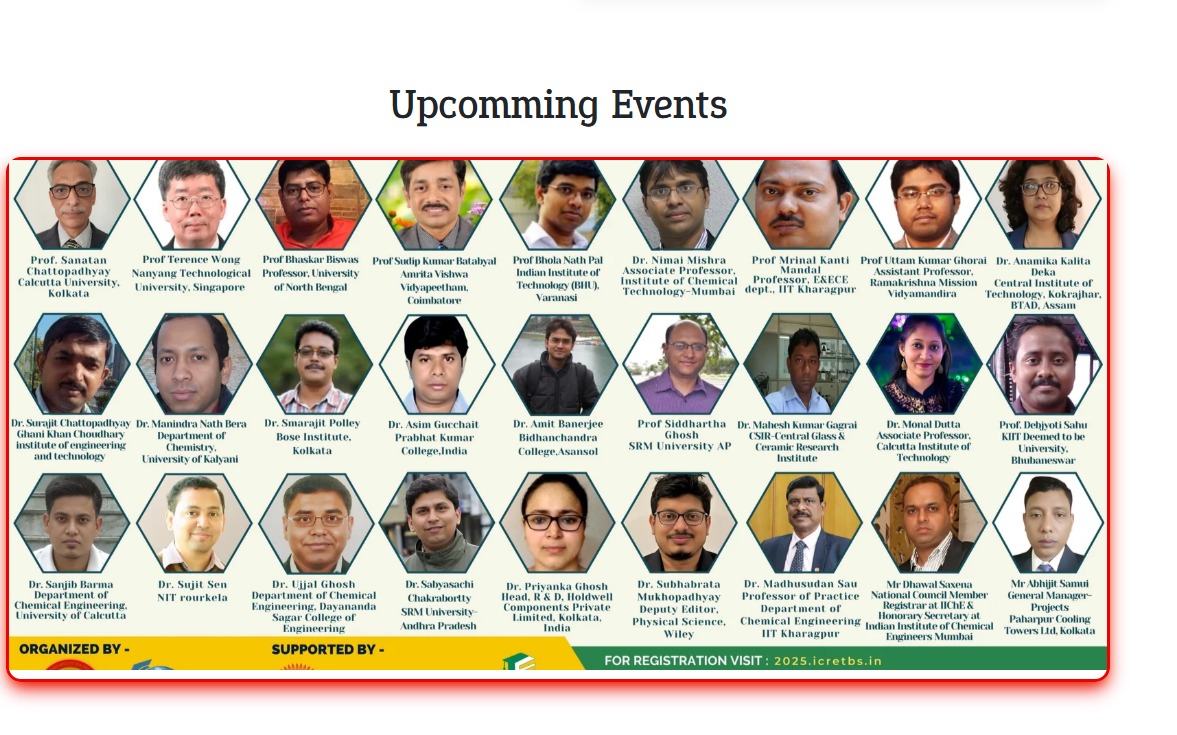
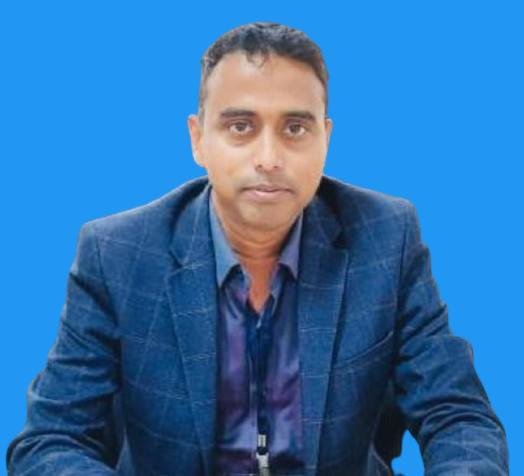
Dr. Nimai Mishra
ICT Mumbai – Indian Oil Odisha Campus
Our Esteemed Organizers & Partners



IISER Pune
RISE TCG CREST

Hydgen, Singapore

NIT Durgapur
An International Conference on Frontier Materials for Energy and Sustainability
Connecting science, innovation and sustainability through advanced materials.
The International Conference on Frontier Materials for Energy and Sustainability (FMES-2027) is envisioned as a premier international forum dedicated to the emerging field of smart and frontier materials that enable sustainable energy technologies and environmental solutions.
The conference will bring together leading scientists, academicians, industry experts, early-career researchers, and students from around the world to exchange ideas, share recent scientific advances, and foster interdisciplinary collaborations in materials-driven energy research.
The global transition toward carbon neutrality and sustainable development demands transformative materials capable of addressing critical challenges in clean energy generation, storage, conversion, and environmental remediation. Smart materials, with their tunable structural, electronic, optical, magnetic, catalytic, and responsive properties, are increasingly recognized as key enablers of next-generation energy technologies.
Read MoreSmart & Functional Materials Clean Energy & Renewable Technologies Batteries, Supercapacitors & Energy Storage Catalysis & Surface Engineering AI for Materials Design & Discovery Advanced Characterization & Microscopy Sustainable & Green Materials Industrial Translation & Emerging Technologies.
Semiconductor nanocrystals, quantum dots, perovskites, metal nanoclusters, MOFs, COFs, graphene, MXenes, 2D materials, hybrid and bio-inspired materials.
Photocatalysis, electrocatalysis, artificial photosynthesis, solar energy harvesting, water splitting, hydrogen production, and CCUS.
Next-generation batteries, supercapacitors, fuel cells, solid-state electrolytes, and integrated energy storage devices.
Structure–property relationships, defect engineering, charge-carrier dynamics, plasmonics, and catalytic nanomaterials.
Machine learning, artificial intelligence, high-throughput screening, DFT, multiscale modeling, and autonomous experimentation.
Electron microscopy, synchrotron and neutron-based methods, ultrafast spectroscopy, in situ/operando, and correlative characterization.
Environmental remediation, water purification, green synthesis, circular economy, waste valorization, and sustainable manufacturing.
Scalable materials, device integration, commercialization, industry–academia collaboration, and smart materials for clean energy applications.











Hydgen, Singapore
NIT Durgapur






After the Conference (If any)